
Yoga vs. Exercise: What’s the Real Difference? (And Why It Matters)
Salutations to the spiritual center of the earth!
You are probably sitting on the fence, in case you are reading this. You could be a gym rat who is wondering why your muscles seem to be in a continual state of tightness, or you may be a total beginner who has just entered a sporting goods store, holding two dumbbells in one hand and a rubber yoga mat in the other.
During our teaching years in the Domain of Rishikesh, we have come across thousands of seekers. A lot come there with an impression that yoga is a simple stretch that people do not want to weigh up. Other people believe that the gym is exclusive to people who are obsessed with mirrors and protein shakers.
The truth? Both are amazing for your health; it’s just that they are both working on different frequencies. To get the actual comparison between yoga and exercise, take a cup of herbal tea, sit back, and we shall get into the depth of movement.
The Essential Philosophy: Work Out vs. Work In.
When we refer to physical exercise, consider running, weightlifting, CrossFit, or HIIT; the first goal is external. You are conditioning the body to do a particular task in a better, faster, or stronger way. You desire to raise the rate of your heart, grow muscle fibers, and lose calories. It is a straight line between points A and B.
However, yoga is a Vedic science that is 5,000 years old. The simple word “yoga” is a derivation of the Sanskrit word “yuj,” which translates as “to yoke” or “to unite.” Although exercise deals with the body as a machine, yoga looks at the body as a temple and a portal to the self.
During a typical gym workout, you are exercising–expenditure of energy, testing your limits, and, in most cases, competing with yourself or with others. You are at work doing yoga, in a yoga practice. The movement of the body is to silence the mind, and you are giving a bridge between your physical being and that of your inner being.
1. The Nervous System: Stress vs. Serenity.
It is, perhaps, the most important difference in biological aspects that should not be ignored.
The Sympathetic Nervous System (SNS) is activated in most cases of strenuous exercise. That is your fight or flight. Cortisol and adrenaline are released in your body when you are sprinting or pushing a heavy barbell. Although this is excellent to develop resilience as well as to lose fat, prolonged presence in this condition may cause burnout and chronic inflammation.
To the contrary, yoga is meant to do that. The Parasympathetic Nervous System (PNS), or the rest and digest system, is what is activated by yoga by means of slow, regulated movement and deep holds.
- Yoga lowers the levels of cortisol: your brain gets to know that you are safe.
- Vagus Nerve Stimulation: Yoga, by use of certain postures (asanas) and breathing exercises, conditions the vagus nerve, thereby controlling your heart rate and your mood.
- Concisely: Exercise is a regulated stressor; yoga is a regulated de-stressor.
2. The Breath: The Fuel vs. The Foundation
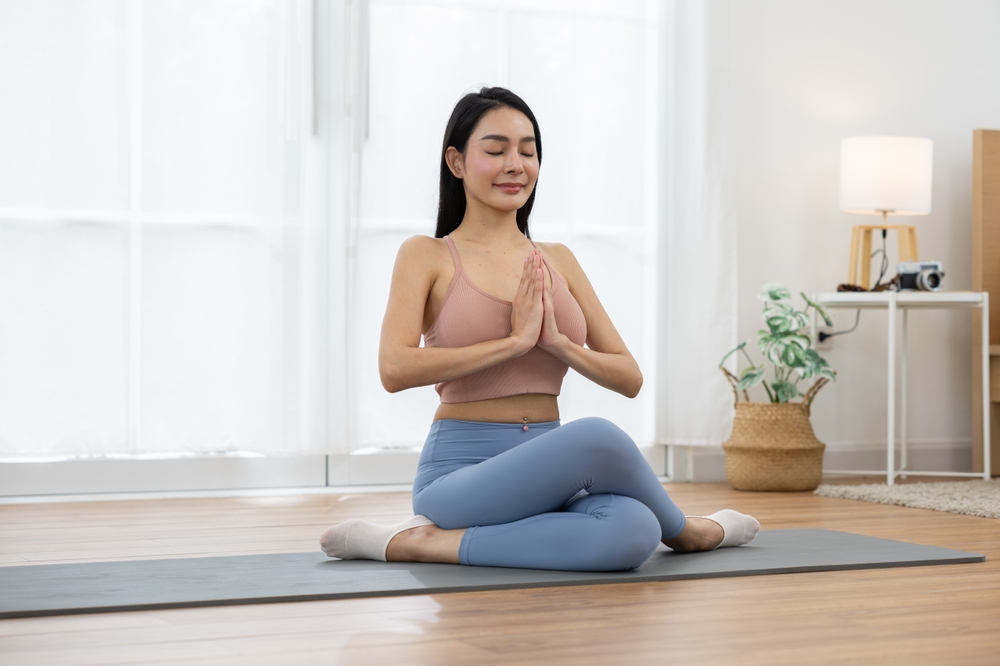
Breathing is not a very common consideration in a normal workout. You breathe because you must; your muscles are aching at their need of breath. You may pant, mouth-breathe, or even hold your breath when performing a challenging rep (which actually positively elevates your blood pressure!).
The most significant aspect of the practice of yoga in Rishikesh is the breath (pranayama). When you are doing a tricky pose and your breath is jagged, then you are not doing yoga.
- Exercise: The muscles use oxygen as their fuel.
- Yoga: Breath is a device that circulates prana (life force energy).
Yogis can reduce their blood pressure by learning to breathe deeply into the diaphragm and expanding the capacity of their lungs in a manner regular cardio does not.
Yoga vs. Exercise: Comparative Dissection.
| Feature | Conventional Exercise | Authentic Yoga Practice |
| Primary Goal | Physical fitness, aesthetics, speed | Self-realization, balance, mindfulness |
| Metabolic State | Catabolic (breaks down tissue) | Anabolic (restorative and healing) |
| Movement Style | Repetitive, often high-impact | Holistic, varied, low-impact |
| Awareness | External (music, mirrors, TV) | Internal (sensations, thoughts, breath) |
| Energy Result | Often leaves you tired/spent | Leaves you energized and calm |
| Long-term Focus | Peak performance | Longevity and joint health |
3. Muscles vs. Joints and Bone.
Look at a bodybuilder, and you have got hypertrophy, that is, the enlarging of the muscle fibers. This is very powerful but in most cases at the expense of mobility. Ever come across a muscular person so fat that he/she cannot even scratch his back? That is the extreme of the limitations of entirely linear exercising.
Yoga dwells upon functional strength. It does not only work on the glamor muscles (biceps, abs, and pecs). Rather, it reinforces the stabilizing muscles and the tendons as well as the ligaments.
Fitness develops mass and muscular strength.
Yoga creates thin muscle, stability, and unbelievable flexibility.
Moreover, yoga is concerned with back health. Half the proverb goes, “In Rishikesh, you are as young as your back is soft.” The twisting, folding, and extending movements of yoga help maintain the spinal discs moist and the nerve system channels open.
4. The Mental Game: Competition vs. Compassion.
In any gym in the modern world, what are you looking at? Mirrors. Everywhere. You are asked to compare your appearance, yes, but to compare your progress with the one beside you. It is a competitive environment in nature.
Yoga requests that you look inside (Pratyahara). In a yoga class, the sole person against whom you are in competition is the yoga-you that had just entered the mat ten minutes ago.
No Pain, No Gain: It is all about exercise.
Yoga is about no pain, no gain.
In yoga, we are taught to pay attention to the voices of our bodies before they turn into screams. This builds a state of awareness and emotional intelligence, which will allow you to remain composed during a stressful meeting or a fight with your family. You get to know that pain is not a permanent thing, and you can push through it by taking breaths.
5. The Spiritual Dimension: The Factor of Rishikesh.
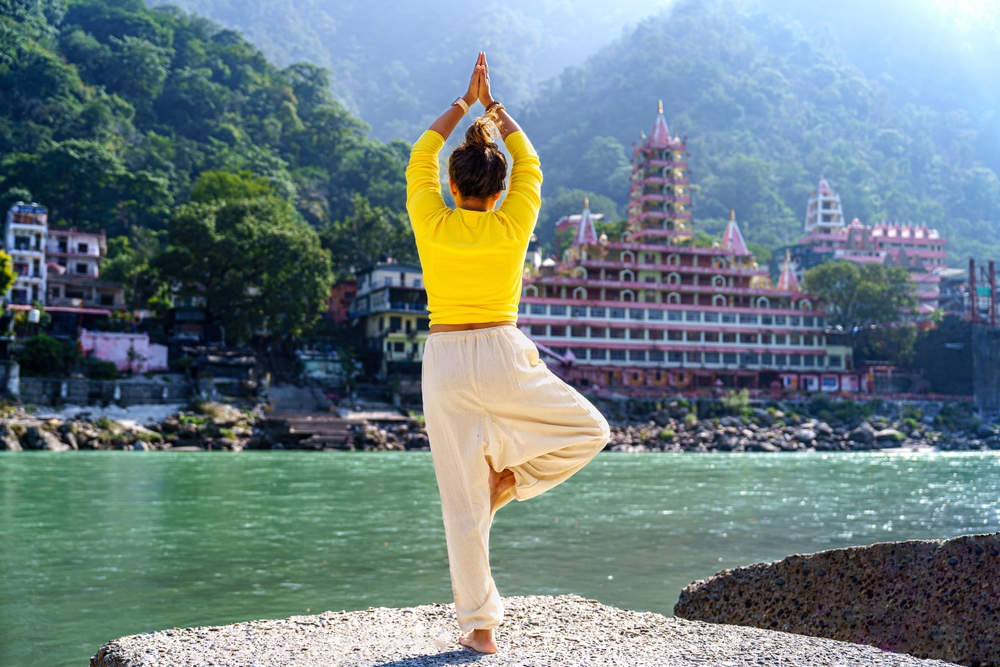
This is where a line of difference is drawn very clearly. You will hardly have a gym regimen that requires you to think about your role in the universe.
When you practice yoga, and in this case, at Rishikesh Domain, there you are working with the Eight Limbs of Yoga. Asana (the physical poses) is just one of such eight limbs.
- Yamas & Niyamas: Ethics and discipline.
- Pranayama: Breath control.
- Pratyahara: Retraction of the senses.
- Dharana and Dhyana: concentration and meditation.
- Samadhi: Enlightenment or Bliss.
Physical activity is exercise. Yoga is a lifestyle. It alters your eating habits, your sleeping habits, your treatment of others, and your reality. It is not only about what you are doing during 60 minutes on the mat but also how you live during the other 23 hours of the day.
The Hybrid Approach: Why You Should Do Both.
Of course we are not asking you to get rid of the running shoes! In my role as a yoga teacher, we would in fact recommend that our students do some sort of cardiovascular work. The heart is a muscle and must be put to the purpose.
The miracles occur as a result of putting them together:
- It is the raw power and bone density that is provided by the gym.
- Yoga teaches you the freedom, the lunges, and the brains to apply that power in a sensible manner.
And yoga will loosen your tight hamstrings if you are a runner. In case you are a weightlifter, yoga will cushion your lower back and make your grip stronger with a better connection between mind and muscles.
Rishikesh: A travel guide on how to begin your journey.
When you feel lost about the yoga vs. exercise argument, the best option you will have is to visit and see the Yoga Capital of the World. This is energy in the Himalayas—the trembling of the mountains and the Ganga—that makes the transformation of the exertion into yoga seem a natural and stress-free occurrence.
This is the gap we help bridge at Maa Shakti Yog, located in the spiritual heart of Rishikesh. Whether you are a beginner exploring yoga for the first time, joining a teacher training program, or seeking deep healing through a retreat, our approach is rooted in authentic yogic tradition.
Summary: The Real Difference
- Maintenance of the body is through exercise. Yoga is a way to transcend it.
- Exercise builds the “house.” Yoga is used to illuminate the lamp within the house.
- Exercise is what you do. Yoga is who you become.
Finally, it is not the movement that is actually different, but the purpose of the movement. In walking consciously, each stride can be yoga. In the case you mindlessly move, even the most complicated yoga position is merely the exercise.
Are you now prepared to quit doing what you are doing, or exercising, and begin to tune in? We would be happy to get your ideas! Do you feel any difference in your mental health when you replace the gym with the mat? Tell us in the comments.