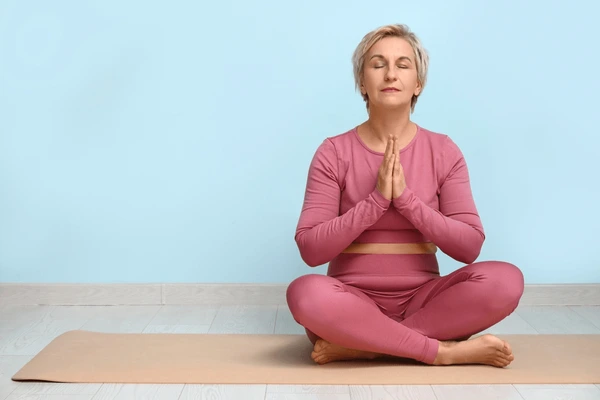
Starting Yoga After 40: Why It’s the Best Move We’ll Ever Make
Another myth that has been put forward is that yoga is only available to the young, the hyper-bendy, or those who already can figure eight into human pretzels. To us who are sailing through the colorful 40s and 50s, though, yoga is not just a physical activity but a maintenance guide, a stress-free zone, and a means of regaining our youth.
When we have realized that our backs are a little stiffer in the morning or we have found our energy levels not being as high as they were before, we are not the only ones. One of the most proactive measures we can take towards our long-term health is to start yoga after 40. It is about accepting our bodies as they are now and creating a platform that will help us into the future gracefully. At Maa Shakti Yog, we believe yoga after 40 is not about perfection. It is about reconnecting with the body, calming the mind, and creating lifelong wellness.
In this guide, we will discuss all that we have to know about the initial steps of this journey, both in terms of physical gains and the psychological changes that will allow a practice to become sustainable.
Why Yoga Is Not the Same After 40
At our age, in our 20s, we tend to exercise in order to alter our appearance. When we reach 40, our priorities are bound to change. We desire to feel good, move without pain, and maintain our minds sharp. It is in this area that yoga excels. Yoga is geared towards functionality and longevity, unlike other high-impact sports that may be hard on our joints.
1. Bone Density: Keeping It Healthy
With aging, particularly in the female population, bone density is one of the primary concerns of our health. Exercises that involve weight are necessary to maintain bone strength and osteoporosis. As yoga involves our own body weight to act as resistance, all poses, such as warrior II or plank, can assist us to sustain and even increase bone mineral density.
2. Muscle Mass (Sarcopenia) Maintaining
Sarcopenia is the normal loss of muscle mass with age. Yoga involves the involvement of the so-called stabilizer muscles, which one tends to disregard in everyday life. Through poses, we develop isometric strength, and as a result, we remain strong enough to face our duties every day, such as taking groceries or playing with our children.
3. Joint Health and Flexibility
As we grow older, the amount of lubricating fluid produced by our joints diminishes; hence, the creaky feeling. Yoga promotes a complete movement. We can maintain the softness and elasticity of the tissues surrounding our joints by stretching them gently and making them stronger, thereby preventing injury.
The Best Yoga Styles for a beginner over 40
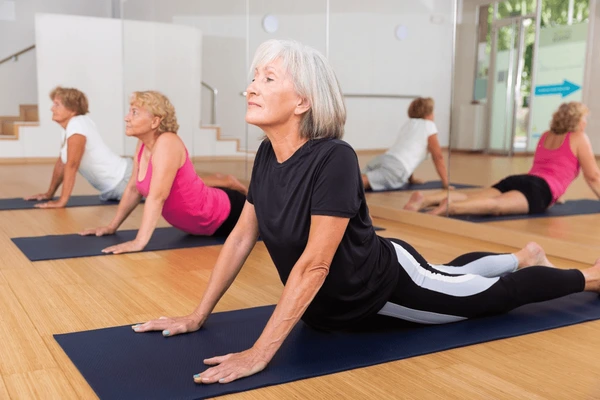
Also Read: 5 Breathing Techniques to Supercharge Your Yoga Practice
When we enter a yoga studio, we feel threatened when we are not aware of the various names. We do not have to get into a high-intensity yoga class right away, which is called power yoga. The following are the styles that we suggest to begin with:
- Hatha Yoga: This is the traditional yoga. It tends to be slower and concentrates on simple poses and breathing. We like it because we have time to get familiar with the position of each pose without being in a hurry.
- Yin Yoga: This type of yoga includes sitting or lying in a position during a few minutes. It attacks the deep connective tissues and fascia. It is so relaxing for the stiff-hipped or lower-back-pained among us.
- Restorative Yoga: When we are living high-stress lives, this is where we can find refuge. Through the aid of props, such as blankets and bolsters, we are able to rest the body, and we are able to relax fully. It is more of being than doing.
- Iyengar Yoga: This form is known to use props (blocks, straps, and chairs). It is also good to start with after 40 since it focuses on proper alignment, hence highly safe for people with physical constraints.
Frequent Problems and Our Ways of Solving Them
So, tell the truth, our bodies have history. We can have some old sporting injuries, tender knees, or a bad back. These are not to prevent, but merely to tell us how to practice them.
Working with the ego
Our hamstrings are not the greatest obstacle but rather our minds. We may see a person of half our age performing a handstand and become demoralized. We must keep in mind that yoga is not a performance but rather a practice.
We are in our 40s and are smart enough to hear our bodies. In case one pose does not feel comfortable, we skip or amend. No pose has a perfect form—the perfect form is that which feels good to us.
Tools, Not Crutches: Props
The assumption that we use a block or a strap is often made, and that we are bad at yoga. We must change that attitude. The props are the tools that bring the floor nearer to us.
They assist us to keep ourselves in the right posture so that we do not overstretch our muscles. Triangle Pose with a block can be used to open our chests and breathe correctly, instead of curling over simply in order to touch the floor.
Important things to keep in mind for our first class
In case we are preparing to roll out the mat the first time, the following are some of the practical tips that we can use to have a good time:
- Hydrate in Advance: No need to fill up a liter of water and chug it before going to class; we will feel it sloshing. Drink regularly during the day before our session.
- Wear Comfy Layers: We will experience changes in body temperature. We begin chilly, become warm in the flow, and get chilly in the closing relaxation (Savasana).
- Come Early: It is always good to allow us a ten-minute time slot to get settled down, meet the instructor, and state any injuries we have. This will enable the teacher to provide us with certain changes.
- Breathe Above All Else: When we find ourselves holding breath, we have gone too far in a pose. Our inner compass is the breath. When it slips by, we are all right. When it is jagged, we must retreat.
Yoga Beyond the Physical: Mental Advantage
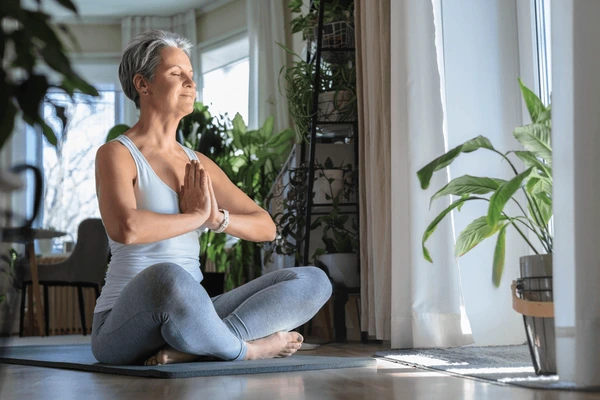
Also Read: The 8 Limbs of Yoga: A Holistic Path to Inner Peace, Clarity, and Spiritual Growth
Whereas the physical benefits are what often get us in the door, the mental ones are what make us go back. Our 40s can be a sandwich phase of life, as we are career-building, have teenagers, and have parents who may be aging. The stress is real.
Yoga is mindfulness. We can learn to remain in the present by training our brains to pay attention to our breath and how our feet feel. This decreases cortisol (the stress hormone), enhances our sleep quality, and leaves us feeling calm long after we get off the mat.
Yoga in a Busy Schedule
We do not have to spend 90 minutes on a mat daily to achieve results. The duration is less important than consistency. This can be done by merely 15 minutes of morning stretching or a few sun salutations, and this can transform the way our whole day will be. We would like to have two to three sessions per week to begin with to give our bodies time to rest between the practices.
In case we fail to get to a studio, there exist unbelievable online resources. But in the case of us who begin after 40 years, we strongly suggest that you take at least some of the classes in person. The alignment of the eye can be checked by a trained eye, which is important to prevent injuries.
Why Rishikesh is the Heart of Our Journey
Talking about yoga, we cannot but refer to its origins. As much as we are concerned about the practice itself, we must recognize the spiritual heritage that guides all we do. When we practice yoga in the Rishikesh domain traditions, we are not performing mere gymnastics. We are of a lineage that is thousands of years old.
In the Rishikesh tradition, yoga is regarded as a complete way. It is not only about the physical postures (asanas) but also how we breathe (pranayama) and how we treat others. Our practice is enriched when we take this attitude. We are not merely stretching; we are tying ourselves to a world of people, to an ancient wisdom.
Lesson: It is Never Too Late to Start
Yoga after 40 is a self-love thing to do. It is a recognition that we appreciate our health and desire to experience the rest of our decades with vitality and acuity. We are not as pliable as we were 20 years ago, but we are far more intelligent. We understand how to take our time, we understand the importance of patience, and we know that real progress occurs breath by breath.
Come on, together on the mat. We should also see what our bodies are still capable of, and we should also enjoy the calmness that a committed practice brings about. We can be seeking to heal a persistent sore or just to have some quiet time in that noisy world, and yoga can offer us a home.
We look forward to our destination on this journey. It is important to remember that unrolling the mat may be the most difficult thing in yoga. The rest is done when we get there.
Checklist to start yoga after 40:
See a physician in case you already have some underlying conditions.
- Get a non-slip mat to cushion your joints.
- To be safe, stick to Hatha or Iyengar.
- Use props (blocks/straps) to aid your position.
- Consistently practice 2-3 times a week.
- Don’t ignore what your body is telling you; pain is an indication to quit, and a good stretch is an indication to take a breath.