Yoga for Stiff Mornings: Gentle Wake-Up Movements
Ever get out of bed and find your body feels like a stone? You are not alone if your initial movements after waking up from sleep involve a lot of grunting, creaking joints, and tense muscles. We come out of bed in the morning, feeling stiff, slow, and disconnected.
What if there’s an alternative way to begin your day? We don’t need to go straight to the coffee machine or through an intense exercise session; we can pick a more relaxed route. The practice of yoga for the morning can make a radical difference in the way we feel, from being rigid and exhausted to being fluid and energized. The practice of yoga for the morning can make a radical difference in the way we feel, from being rigid and exhausted to being fluid and energized. At Maa Shakti Yog, we encourage simple daily yoga rituals that reconnect the body, breath, and mind naturally.
We will discuss why waking up is so stiff and take a simple, thorough sequence of waking movements to open up the joints and muscles. These movements are based on the traditional knowledge that passes through Rishikesh, the world’s yoga hub, and serve only to be functional and kindle awareness of the breath in us to usher in a perfect day.
What is the reason why we wake up stiff the next day?
First, let’s focus on the science behind the tightness in the morning. Our body cools off and circulates more slowly during sleep. Our muscles are at rest, but our fascia, the mesh of connective tissue that surrounds each muscle and organ, becomes denser and less fluid because of hours of stillness.
Moreover, the fluid properties of our joints alter as we get older and with our daily stresses. If the joint is not moving, then the synovial fluid (lubricating fluid) does not flow completely. This mixture of nonmoving fascia and nonactive joint fluid can cause that familiar “stiff morning” feeling.
We can use gentle morning yoga poses to act as our own personal alarm clock. We gently squeeze and elongate the tissues, bringing in new, oxygen-rich blood to our muscles and encouraging synovial fluid production.
Creating a morning routine environment
Also Read: 7 Powerful Yoga Poses to Help You Lose Weight Naturally
It is most important to maximize the benefit of this practice: we do not need to have an expensive studio or a lot of equipment. Just a place that we can move around in without the noise.
- It’s easy to practice on the floor: You can practice these first few movements in bed, or you can roll out a mat on the floor next to your bed.
- Breathe deeply and steadily: The trick to relaxing stiff muscles is deep, steady breathing. We wish to practice deep breathing into the ribs and belly and to breathe out as if we are deflating.
- Follow your body’s instructions: “Morning tissue is delicate; listen to us. Respect your body: Never stretch or push beyond the point of pain. Consider these movements a “gentle invitation” to the body to open up, rather than a “must do.” Imagine that these movements are an invitation and not a mandate.
The Gentle Wake-Up Sequence: Step-by-Step
Let’s take a quick look at one simple, effective sequence we can do each and every day to counter the stiffness in the morning.
1. Supta Utthita Tadasana (Reclined Full-Body Stretch):
Let’s begin before we get out of bed. This movement helps our nervous system to know that it’s time to move on to the day.
- Perform: Lie face up, arms extended overhead and legs long. Interlace fingers and position palms away from the body. As you take a big breath in, extend your fingers down to your toes. Extend through your torso, and feel your rib cage rise. When you exhale, relax and release.
- Why it works: This trivial movement sends an instant signal to our spine to realign and starts to stretch the deep fascia along the front and back of our bodies.
- How long: 3-5 deep breaths.
2. Wind-Relieving Pose (Pawanmuktasana Variations)
We can often find this stiffness in our low back and hips in the morning. This soothing stretch gently awakens digestion while working on the lumbar spine.
- How to do it: Keeping your back flat, bend your knees and hug them softly to your chest. Place arms on knees. Here take a few deep breaths, feeling the belly push into the thighs as you breathe in. Try to rock slowly from side to side to massage the back of your lower back on the floor or mattress if it feels good.
- How it helps: This move opens up the lower back, stretches out the buttocks, and gently arouses our abdominal organs, awakening our digestive system.
- Duration: Rock or hold for approximately 1 minute.
3. Cat-Cow Stretch (Marjaryasana-Bitilasana)
Also Read: Mudras: The Forgotten Yogic Language of Energy
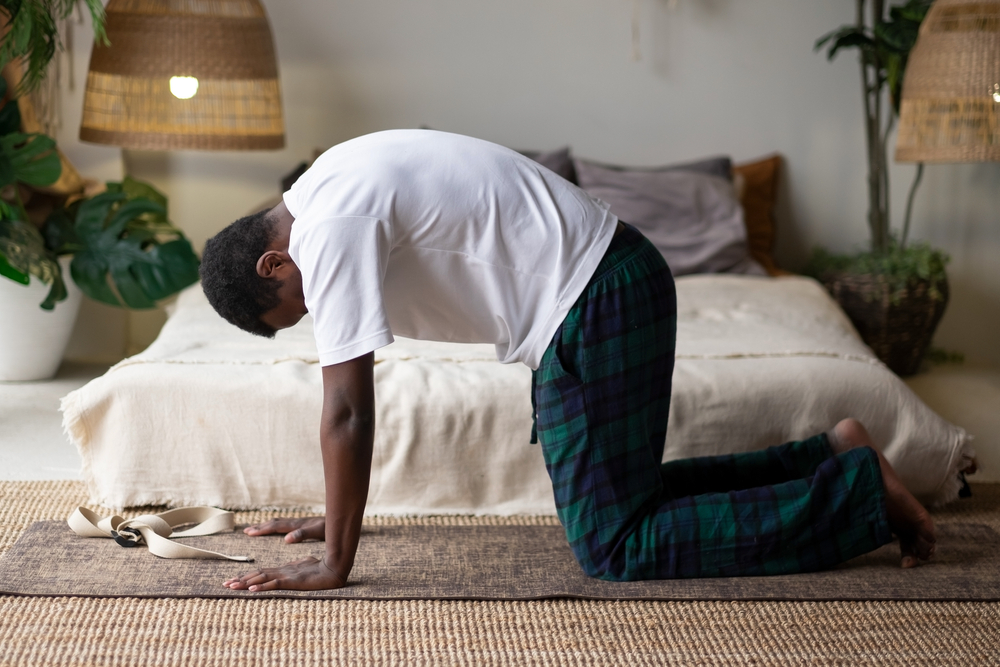
Let’s now move onto the floor on our hands and knees. If feeling sensitive, place a soft blanket underneath your knees. It’s the gold standard for spine health.
- The movement: Wrists directly under shoulders and knees under hips. When you inhale, sink your belly towards the floor, lift your chest and lift your gaze, and draw your tailbone towards the ceiling (Cow Pose). While exhaling, press into your hands, round your spine up to the ceiling, pull your chin to your chest, and pull your belly button in (Cat Pose).
- How this works: The cat and cow will stretch the spine and loosen the muscles around the spine. Connects our breath with our movement, giving us a sense of being present immediately.
- Duration: Make the rounds for 5-8 complete breaths.
4. Extended Side Angle Pile Driver Pose (Extended Sidelying Pile Pilot Pose)
This is the time to stand down and expand the narrow, constricted spaces next to the sides of our bodies.
- To perform: On all fours, touch big toes together and spread the knees out to the sides of the mat. Sit back on your heels, reaching your arms long in front of you, and move your forehead down toward the floor. For the side stretch, walk both hands slowly to the right side of your mat until you feel a great stretch along the left side of your body. Exhale and then stroll hands back through the center and across to the left side.
- Why it works: Balasana opens our hips and eases the tension in our lower spine, while the side-bending variation targets intercostal muscles between our ribs and latissimus dorsi muscles in our back, which may become tight if sleeping on the side.
- Duration: 3-5 deep breaths per side.
5. Gently facing downward dog (Adho Mukha Svanasana)
If your hamstrings are really tight, don’t worry about this version being too hard; we’re going to keep it very soft and accessible.
- Instructions: Bring hands back to the front of the mat, spread fingers wide, tuck toes under, and lift hips high and back. Don’t straighten your knees so close that your spine becomes shortened and hunched. Start “pedaling” your feet (one heel down to the mat and the other knee bent) and alternate sides.
- How it works: This inversion increases the flow of blood directly to our brain to give us a natural ‘pick-me-up.’ ‘Footspeed is a gentle stretch of the calf, hamstring, and Achilles tendon without overloading them.
- Duration: Hold the pose for 5 even breaths, concentrating on length in the spine as opposed to straightness in the legs.
6. Closed Uttanasana Variation (Dangling Forward Fold)
Also Read: The Five Sheaths of the Soul: Understanding Pancha Kosha
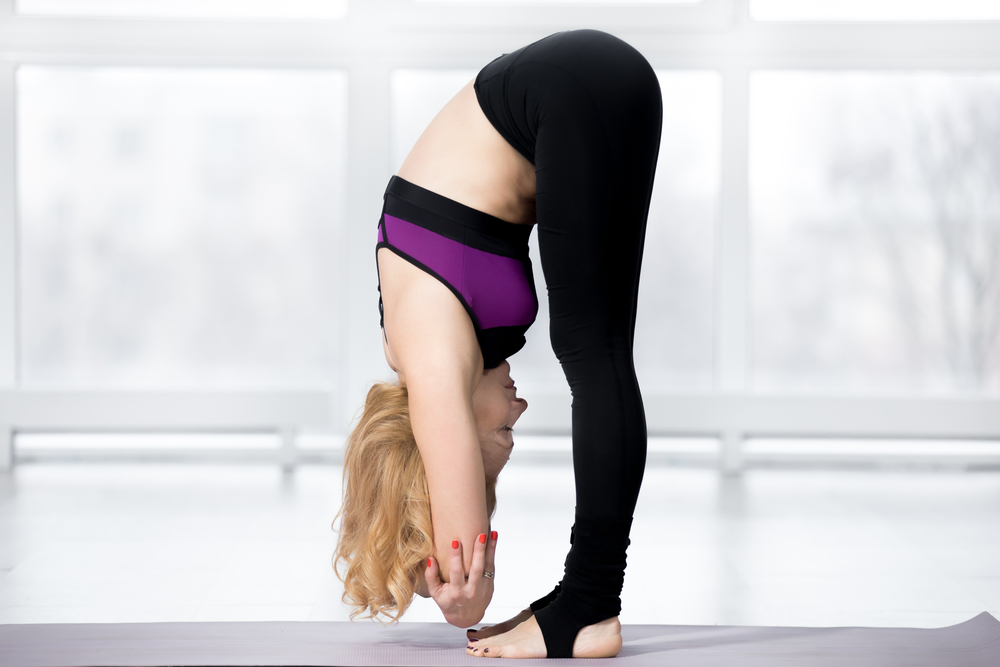
Let’s let gravity do the heavy lifting for us and get our feet on the ground.
- How to do it: Move feet slowly towards hands, feet hip-width or wider. Raised hands bend knees deeply to allow the torso to literally be placed on knees. Allow head, neck, and shoulders to drop down completely. Hold opposite elbows with hands and sway side to side as if you were a rag doll.
- Why it works: The pose is fantastic for opening up the upper back, neck, and shoulders. Keeping the knees bent, we fully protect our lower back and still receive a beautiful and passive spine decompression.
- Duration: Hold heavy for 30-45 seconds; slowly roll up to standing, vertebra by vertebra.
Golden Rules for an Effective Morning Yoga Practice
Let’s keep a few important points in mind as we make this regular habit a transformative part of our life:
- Drink First: Let’s drink a cup of water before getting on the mat. This allows our tissues to rehydrate from the inside, as well as the outside, and increases our muscles’ and fascia’s pliability and sensitivity to stretching.
- Practice Doesn’t Have To Be Hour-Long: We don’t have to practice for an hour to get results. A regular 10–15 minute morning routine each day is much more beneficial to our long-term flexibility and energy levels than a 90-minute class once a week.
- Respect Your Limits: We will be more flexible some mornings than others based on our sleep and/or prior activities. The boundaries of our bodies are unique each day, and we must respect them. Yoga is not about fitting into a perfect position and shape; it is about feeling our own body.
The Power of True Yoga
These movements are part of a thousand-year-old legacy of self-care and mindfulness. This sequence can be performed anywhere in the world but has deep roots in the traditional centers of wellness in India, such as Rishikesh, where the emphasis is on the holistic approach.
Here, yoga isn’t seen as a sport or just a physical exercise. Rather, it is seen as a practice done every day to bring harmony to the body, breath, and mind. When we include this same mindful intention in our daily morning practice, we take that calm and grounded presence with us in our contemporary lives, regardless of where we live.
Move from the past to the present.
After our final standing stretch, we can take a few seconds to stand tall in Mountain Pose (Tadasana). So let’s put our hands over our hearts with our hands over our bellies and take a last big inhale and a slow, deep, clearing breath.
Notice the shift. Do you have a bit more range of motion in your joints? Do you have a little more freedom in your breathing? Do you hear a bit of silence in your mind?
These simple stretches only take a few minutes to perform in the morning and help to eliminate stiffness and move the day in a proactive and calm way. Let’s take a pledge to try this sequence tomorrow in the morning! It’s going to make our minds and bodies thank us for it!
Ever done yoga in the morning before? How do you get rid of stiffness in the morning? Give us a comment below – we’d love to hear about your morning rituals!